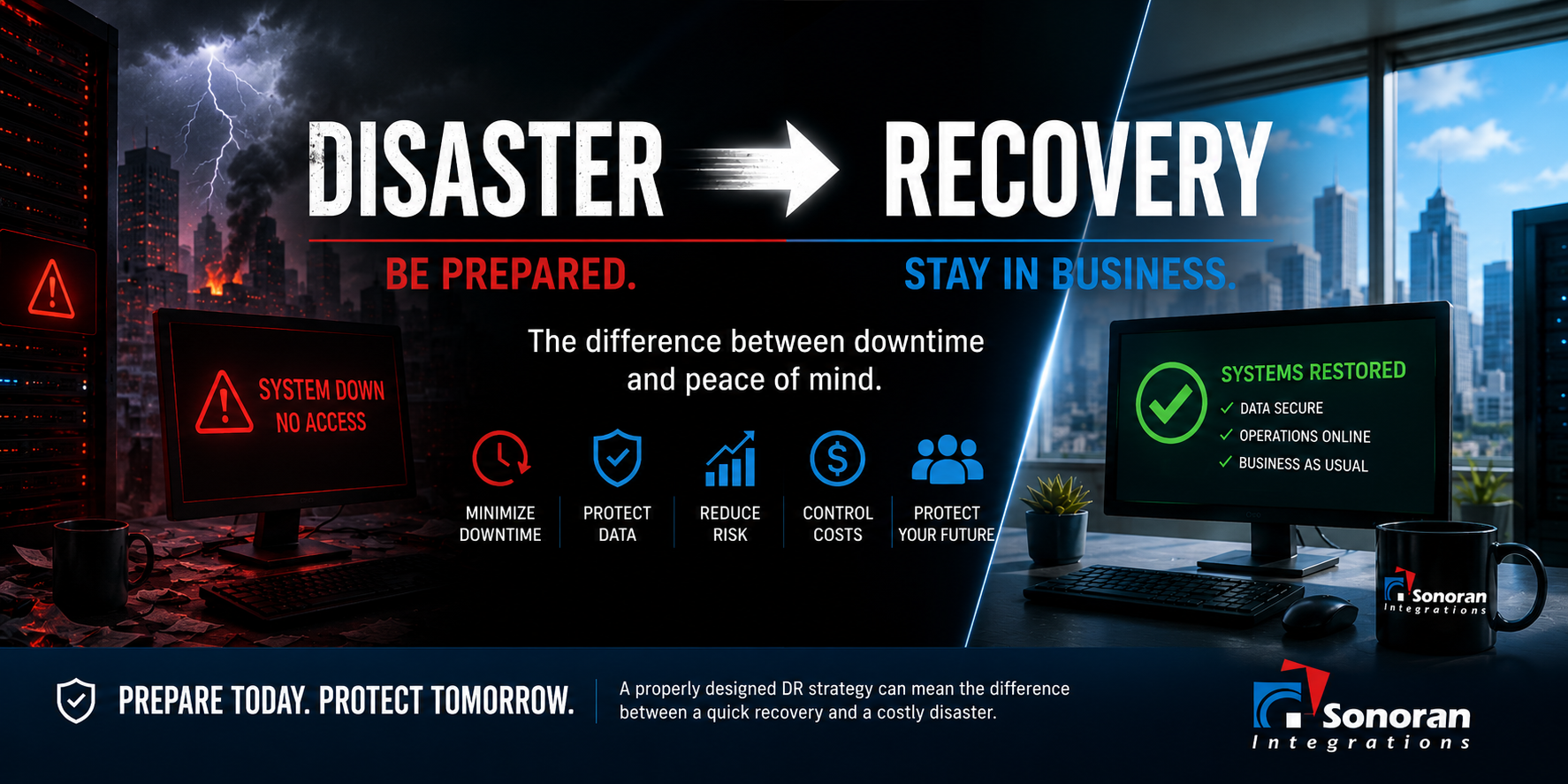
The Question Every Business Needs to Answer: What Happens the Day After Disaster Strikes?
Last year, one of our clients came in on a Monday morning to find their systems locked down by ransomware. Files encrypted. Operations frozen. The kind of moment that, for most companies, marks the beginning of a very bad year — or the end of the business altogether.
Here’s the difference: they had a real disaster recovery plan in place. Within hours, not days, their critical systems were restored from clean, isolated backups. No ransom paid. No data lost. No extended outage that bled into weeks of lost revenue and customer trust. By the time competitors would still be assessing the damage, our client was back to business as usual.
That’s not luck. That’s what a properly designed DR strategy is supposed to do.
The Numbers Don’t Lie
Disaster recovery isn’t a “nice to have” anymore — it’s the line between businesses that survive a major incident and businesses that don’t:
- 93% of companies without a disaster recovery strategy go out of business within a year of a major disaster.
- 96% of companies with a trusted DR plan survive.
- Half of all companies have experienced outages lasting more than a day in the past five years.
Read that first stat again. Without a plan, the odds are stacked against you almost 10 to 1. With one, they flip almost entirely in your favor.
And yet, a surprising number of organizations remain unprotected — or worse, think they’re protected when they’re not. Many businesses believe their current backup approach is “good enough” until the day it’s tested for real. That’s usually the worst possible time to find out it wasn’t.
It’s Not Just Ransomware
When people hear “disaster recovery,” they often think about natural disasters or major outages. In reality, the threats that trigger a DR event are far more common — and far closer to home:
- Ransomware and malware — the fastest-growing threat to businesses of every size
- Accidental deletion — one wrong click, one dropped table, one overwritten file
- Disgruntled employees — insider risk is real risk
- Hardware failure — servers and storage don’t fail gracefully; they fail suddenly
- Natural disasters — fires, floods, storms, power grid failures
- Compliance audits — proving your recovery capability, not just claiming it
Any one of these can bring a business to a standstill. The question isn’t if something will eventually go wrong — it’s whether you’ll be back online in hours, or whether you’ll be explaining to customers why you’ve been dark for a week.
What “Real” Disaster Recovery Actually Looks Like
Too many companies confuse backup with disaster recovery. Backing up your data is necessary, but it’s not the same as being able to recover quickly, cleanly, and completely. Real DR means:
- Fast recovery time objectives (RTOs) — minutes, not days
- Tight recovery point objectives (RPOs) — losing minutes of data, not a full day’s work
- Non-disruptive, regularly tested failover — so you actually know it works before you need it
- End-to-end encryption — protecting data in flight and at rest
- A model that fits your infrastructure — without forcing costly conversions or rebuilding your environment from scratch
The businesses that recover fastest from a ransomware attack or outage aren’t the ones with the most backups — they’re the ones who’ve actually tested their recovery process and know, with confidence, how long it takes and what it costs them if something goes wrong.
Ask Yourself These Questions
Before disaster strikes is the only good time to ask these questions. If you’re not sure of the answers, that’s worth a conversation:
- What’s your actual recovery time? Not what you hope it is — what you’ve tested and confirmed.
- Does your leadership team agree on acceptable downtime and data loss? Many organizations discover, mid-crisis, that IT and leadership never aligned on this.
- How often is your DR infrastructure refreshed? Is your current model even sustainable, cost-wise?
- Is your team spending time managing DR infrastructure that could be spent on work that actually moves the business forward?
We’ve Seen What Preparedness Looks Like
We’ve helped clients walk away from ransomware attacks, hardware failures, and full site outages with minimal disruption — because they had a plan, tested it, and trusted it when it mattered most. We’ve also talked to plenty of companies who assumed they were covered, only to discover gaps the hard way.
If you’re not confident in your answers to the questions above, or if it’s been a while since you’ve genuinely tested your recovery plan, let’s talk. A conversation now costs nothing. Finding out you’re unprotected during an actual incident costs everything.
Reach out to our team to talk through your current DR strategy and where the gaps might be.